Table of contents
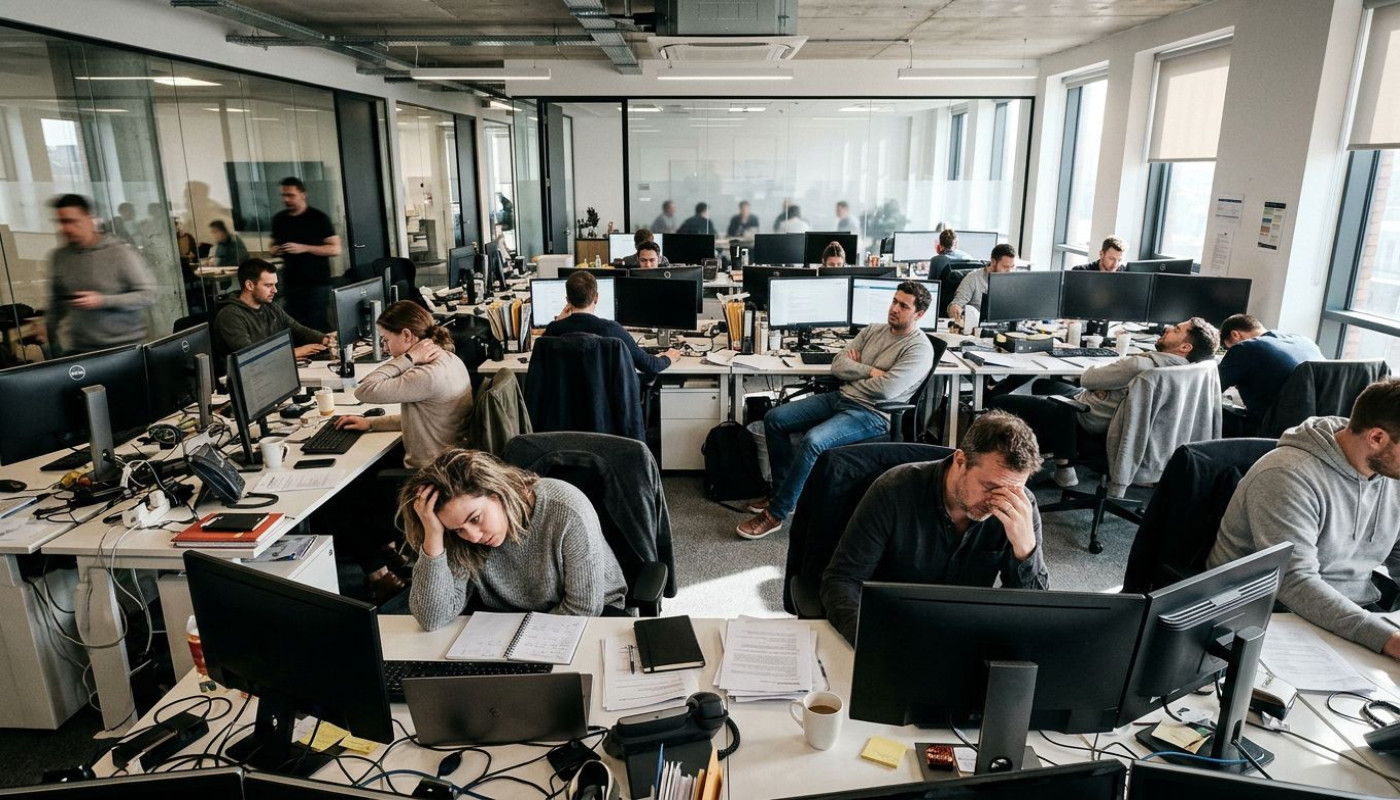
Open-plan offices are staging a quiet comeback, even as companies trim real estate and push hybrid work into a new “three days in, two days out” normal. Yet alongside the cost logic, another curve is rising: reports of fatigue, distraction and creative strain, especially in roles that depend on deep thinking. If the open office was once sold as a catalyst for collaboration, many workers now describe it as an accelerant of burnout, and the data suggests the trade-off is no longer easy to ignore.
Noise, interruptions, and the creativity tax
How creative can you be when you cannot hear yourself think? That question sits at the heart of the open-office debate, because creative work is not only about ideation sessions and whiteboards, it is also about sustained attention, memory and the ability to build complex ideas over time. Research has repeatedly linked open-plan layouts to higher levels of distraction, and not only because of volume; unpredictable sound, passing conversations and constant movement impose a cognitive “switching cost”, a drain on working memory that makes it harder to return to a task at the same level of depth.
Several widely cited studies have put numbers on that drain. A 2018 study in Philosophical Transactions of the Royal Society B (Irving, Davis and colleagues) found that open-plan offices reduced face-to-face interaction by around 70% while increasing electronic communication, suggesting that the “collaboration” promise can, paradoxically, produce more messaging and less meaningful exchange. Other research, including work discussed by the American Psychological Association, points to noise and interruptions as consistent sources of workplace stress, and stress is a known suppressor of divergent thinking, the kind of mental flexibility that supports creative problem-solving.
It is not just about decibels, it is about control. Environmental psychology has long emphasized that perceived control over one’s surroundings affects stress levels; when workers cannot decide whether to take a call privately, whether to avoid overhearing sensitive discussions, or simply whether to protect a block of focus time, the sense of autonomy erodes. In knowledge work, autonomy often functions as a buffer against burnout, and without it, the day becomes a sequence of small compromises: a draft rewritten because a nearby conversation broke concentration, an idea dropped because there was nowhere to sketch it without being watched, a meeting booked simply to secure quiet space.
For creative teams, the “creativity tax” can be subtle. Designers, writers, engineers and strategists may still deliver, but at a higher internal cost, relying on after-hours catch-up, longer ramps back into flow, and more emotional depletion. Burnout, as the World Health Organization frames it in ICD-11, is an occupational phenomenon characterized by exhaustion, cynicism and reduced professional efficacy, and open-office conditions can amplify all three when they turn every workday into a contest for attention.
When collaboration becomes performance pressure
Everyone can see you, and that changes everything. Open offices do not merely remove walls; they reshape social dynamics, because visibility can create a constant sense of being evaluated, even in teams with healthy cultures. That “always on” atmosphere can push workers into performative busyness, where appearing responsive matters as much as producing thoughtful work, and in creative roles, that is a direct path toward shallower thinking and longer recovery cycles.
Organizational research has repeatedly highlighted the importance of psychological safety for creativity: people take risks, share early drafts and propose unconventional ideas when they do not fear embarrassment or punishment. In an open-plan space, however, experimentation can feel exposed. Brainstorming out loud, prototyping rough concepts, or simply staring into space to incubate an idea may read, to others, as not working. For junior employees, or anyone already dealing with impostor feelings, that pressure can become chronic, and chronic pressure is one of the clearest predictors of burnout symptoms.
The collaboration argument also often overlooks an inconvenient reality: not all collaboration is productive. Open layouts can increase unplanned interactions, but they can also increase interruptions that fragment teams into reactive patterns, and that reactivity is exhausting. When you are interrupted, you not only lose time, you lose the mental context you were building, and reconstructing it is work. Even if each interruption feels small, the accumulated load across a week can be significant, especially in jobs where deliverables require synthesis, originality and careful judgment rather than simple throughput.
Companies that rely on open-plan design to “spark” creativity may, unintentionally, be demanding a paradox: more output that depends on deeper focus, delivered in an environment that makes deep focus scarce. The result can be a slow drift toward burnout, not always dramatic, but measurable in error rates, lower novelty in ideas, and the creeping feeling of being busy without progressing. For readers who want a deeper, data-backed overview of these mechanisms and the evidence behind them, you can learn the facts here now.
Hybrid work shifts the burden to office days
Office days are becoming “collision days”, and that matters. In a hybrid model, many employees reserve home time for deep work, and office time for meetings, alignment and social connection, which sounds reasonable until you consider what the modern open office does to the very activities that hybrid schedules concentrate. If everyone comes in on the same days, noise rises, meeting rooms fill up, and the open floor becomes the overflow space for calls, quick huddles and back-to-back conversations.
This creates a new kind of strain: the compressed office day. Employees arrive to a packed calendar, attempt to squeeze in focused tasks between meetings, and navigate a physical environment that offers fewer quiet options than before. The cognitive load increases because the day becomes less predictable, and unpredictability is a known stress amplifier. In practice, many people compensate by extending their workday, finishing the “real work” after returning home, which blurs recovery time and pushes them closer to the exhaustion component of burnout.
Hybrid also changes how fairness is perceived. If some workers can choose quieter days or secure better seating, while others are stuck in the noisiest zones, resentment builds, and burnout is not only an individual condition; it is often a social one, tied to inequity and lack of control. Add in the growing prevalence of video calls in open spaces, where people feel they must be both professional and unobtrusive, and you get a daily tension that is hard to sustain. The office becomes a stage, the camera a magnifier, and the open floor a backdrop that rarely cooperates.
There is another twist: creative burnout is not always about too much work, it can be about too little meaningful work. When office days become dominated by meetings and interruptions, creative professionals may feel their best skills are underused, and that mismatch between effort and impact can fuel cynicism. In other words, the open office can accelerate burnout not only by increasing demands, but by eroding the sense that the demands are worth it.
Design fixes help, but culture decides outcomes
There is no magic layout, but there are better choices. Evidence and lived experience both suggest that the open office is most harmful when it is treated as a one-size-fits-all solution, rather than a flexible ecosystem. Practical mitigations exist: more enclosed rooms, phone booths, quiet zones with enforceable norms, sound-absorbing materials, and seating strategies that separate high-talk teams from focus-heavy roles. Yet even the best acoustic panels cannot compensate for a culture that celebrates constant availability.
The most effective interventions often combine design and policy. Organizations that protect focus time, set clear expectations about responsiveness, and normalize “do not disturb” signals can reduce the interruption rate without sacrificing collaboration. Meeting discipline matters too: fewer meetings, shorter meetings, and better agendas can prevent the open floor from becoming a spillover space for conversations that could have been asynchronous. In environments where managers model boundary-respecting behavior, employees report less pressure to perform productivity, and creative work becomes more sustainable.
It is also worth acknowledging individual differences. Neurodivergent employees, people with anxiety, and workers with sensory sensitivities can be disproportionately affected by open-plan stressors, and inclusive design is increasingly a legal and reputational consideration, not merely a perk. Burnout has direct costs as well, through turnover, absenteeism and reduced performance; industry estimates vary, but the broader literature consistently ties burnout to higher attrition and healthcare usage. For employers, the open office may look efficient on a floor plan, yet expensive in the metrics that matter most: retention, quality and long-term innovation.
Finally, the conversation should shift from ideology to measurement. Companies can track interruption rates, room utilization, employee sentiment, and even the time it takes to complete complex tasks across different setups, then iterate. Open offices are not inherently doomed, but when they are treated as a default, and when the burden of adaptation falls entirely on workers, creative burnout becomes less a risk and more a predictable outcome.
What to do before signing the lease
Before committing, audit your needs. Tour spaces at peak hours, price in acoustic upgrades, and reserve budget for booths and enclosed rooms; many landlords will negotiate fit-out contributions. Ask about local aids for workplace adaptation and disability inclusion, then pilot the layout for a small team before scaling, because fixing burnout later costs more than designing against it upfront.
Similar

Exploring The Impact Of Diverse Payment Options On Virtual Goods Purchases

AI and Machine Learning: The Future of B2B Sales

Integrating Marketing Automation To Streamline Operations

Is An Online Legal Platform Safe For Handling Legal Documents?
